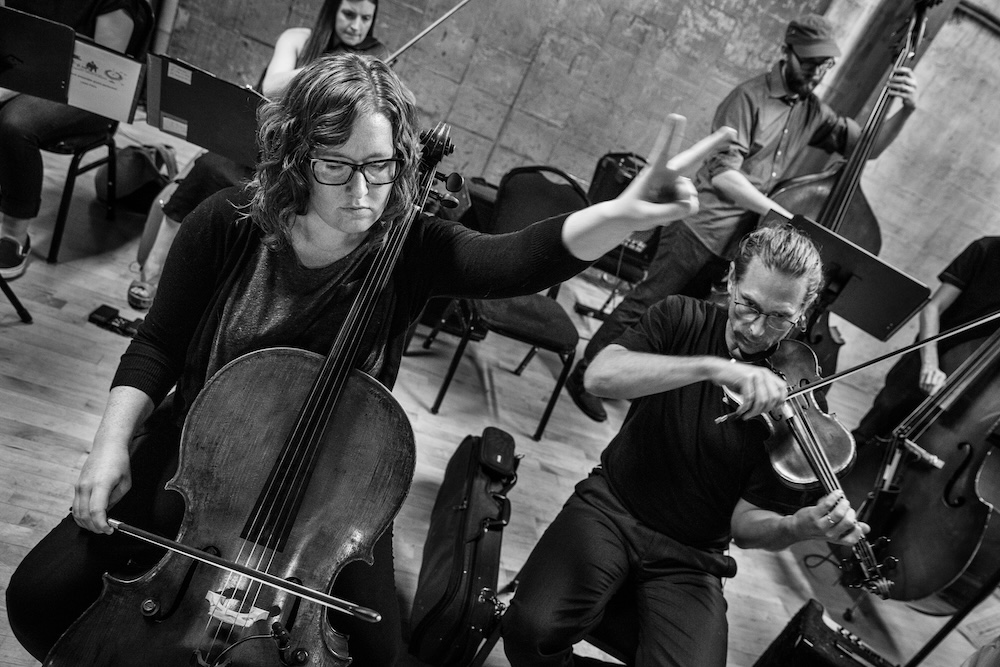
photo credit: Eron Rauch
Jennifer Bewerse is an award-winning cellist and composer based in Los Angeles. A native of Florida, Jennifer received her Doctorate in Contemporary Performance at the University of California in San Diego. We spoke over Zoom in September 2025 about her nonprofit and creative projects. This interview has been edited for space and clarity.
Adam Scott Neal: Let’s start with Music for your Inbox [now called “Middle Ear Project”]. How did that idea start, and how is it going? I would love to know the nuts and bolts of the business side of it, too.
Jennifer Bewerse: I do Music for Your Inbox with my partner, Cassia Streb. It was a pandemic project.
I got my doctorate at the University of California, San Diego, and a big part of my research was in “liveness.” Recordings are amazing, but as a performer, I had to interrogate: why am I doing what I’m doing? What is essential about it? What is better served by recordings or other media?
When the pandemic hit, a lot of organizations, in a very impressive pivot, just went straight to streaming. But these ideas of liveness were still very present in my practice, and in my interests and my research. The live streaming during the pandemic was leaning into a lot of the worst characteristics of liveness and losing a lot of the best characteristics. For example, inflexible timing, like I have to be here at a certain time, I might need to get childcare, I might need to adjust my schedule. I can’t pause, I need to plan ahead, and all these little accessibility issues as well.
So there was some of the contingency of liveness, but you didn’t have the benefit of a shared acoustic space or a communal experience. To me, what was really exciting about streaming mediums were the way you could see multiple perspectives of a performance that you wouldn’t normally get access to. And people could engage with it in ways that worked for them. You can control your environment, you can control the volume, and it can be mixed beautifully.
Anyway, Cassia and I were talking about a lot of this, and we wondered, what if we recorded really beautiful performances, and then emailed it to people, so they could watch it anytime they want? And then we thought, it would be great if there was something you could touch. What if people got something in the mail, too? And that’s when we came up with the idea of making postcards with a piece of visual art on them.
And then in a freak accident of the world, one of Cassia’s mentors contacted her and said, my friend runs a foundation, and they’re looking for a project to give $10,000 to, and I think it should be that idea you have.
Over a frenetic weekend, we put together a proposal and named it Music for Your Inbox. And pitched to do just four months of it. They approved it, and they gave us $10,000 to pay people to perform and to record and film the performances. At the end of four months, we had a really positive response, and so we said, well, what if we did six months. And then we’ll do a year, and then here we are five years later. It has had its own momentum and support, and we’ve just been keeping on going on it.
Adam Scott Neal: That’s just so cool the serendipity of it, we’ve got this cool idea, and then, by the way, here’s some money. That’s really awesome.
Jennifer Bewerse: It was a bit of that “be ready for when luck happens” thing. The woman who had the money was debating between giving it to CalArts for a single performance, or to a project, and Cassia’s mentor really advocated for us. It was a super weirdo project that we just dreamed up, and then it happened.
Now, we’re a non-profit. Our non-profit name is Middle Ear Project, and we have four programs now. There’s our virtual programming, which is Music for Your Inbox. But the smallest run you can print the postcards in is 1,000 so we have all these postcards coming out our ears. We had the idea to offer them to libraries, so we’re now partnered with seven libraries throughout Los Angeles County. And we drop off 100 postcards to them every other month, and then the librarians place books that go with the themes of the art. People can take the postcard home, and there’s a QR code to scan and see the film. So, it’s a really low-effort for the library, high-reward resource for people to get experimental contemporary art even if they’re not super connected to the “art world.”
We hold screenings in LA about three times a year to show the films we commission in a community setting. And in 2021, Instagram had recently rolled out this live feature, and we thought it would be interesting to interview the artists we were presenting. Now we have an archive of over 50 interviews with artists, talking about their practice and their work. Now we have an archive of over 50 interviews with artists, talking about their practice and their work. We’re building this archive of film art that we’ve commissioned, and also artists talking about their work. And it’s just the two of us on a hamster wheel.
Adam Scott Neal: The biggest question for any of these things is starting with nothing, see if there’s enough buzz that we can get some funding.
Jennifer Bewerse: Cassia and I volunteered for the first year, and we paid other people to make the art, but we just did it as a passion project. And then, I was working with Beth Pickens, who advises people in creative fields, and she was really adamant about paying ourselves as early as possible, even if it was just the tiniest amount, and we were both really uncomfortable. But we realized that the whole project hinged on our passion, and if that changed, or something happened to one of us, the whole thing just fell apart.
Our budget’s really small. We’re really scrapping for resources, and trading favors, and it’s a lot of grassroots community stuff. Now that we’re a non-profit, a huge part of our jobs is just trying to get money. We hold two fundraisers a year, and we applied to somewhere between six and eight grants, and it’s a lot of work, and we’ve been trying to promote all of our stuff, so people buy tickets. We’re almost always fundraising in some way, figuring out how to get the money in, so people can get paid. It’s fatiguing, and it’s definitely the least inspiring and maybe most necessary part of running a non-profit.
Adam Scott Neal: I think that’s probably the part people forget about, too. People who get into starting a nonprofit, we’re all idealists, right? And so we want to do the art, or the community service aspect, and really, a lot of it’s just the salesmanship, of convincing someone else of the value.
Jennifer Bewerse: Yeah, we’ve gotten pretty good at describing why we believe art is essential, but the harder thing is actually describing who we are and what we do. Because we’re this weird in-between. The final medium is film, but film people look at it and say it’s music. And then there’s the visual art component. That’s been the big challenge for us, and something we’re always working on.
Adam Scott Neal: How do you balance this project with your other work?
Jennifer Bewerse: It’s hilarious what things can just take over. Cassia and I are both really active artists, and we’re constantly asking “how do we keep this thing right-sized? How do we keep it at bay?” Because it’s a never-ending list of things we could do. So it’s just a matter of keeping it right-sized and chugging along, and we also do a lot of tracking of metrics. We track our happiness.
Adam Scott Neal: How do you assess that?
Jennifer Bewerse: Every single release, we rank the perceived rate of exertion. That’s something we borrow from exercise (Cassia is a really athletic person). This idea of the rate of perceived exertion means that you don’t just have a room and say, everyone do 25 sit-ups, because for some people, 25 sit-ups is too easy and for some people, it’s really hard.
So we rate every release on a color scale: blue being “hey, I could do this all day,” and red being “I… I’m pretty wrecked after that.” And anything can fall into exertion, like too many people to wrangle. The post-production became a nightmare. Someone was a total jerk, and just made it very stressful. So we track that, and then we also started tracking whether it was a creatively inspiring project for us, because when you’re helping other people make art, you can forget that you need that. You have to feel creatively fulfilled, too. So we started tracking on a scale of 1 to 5, how much creative inspiration did you get out of it?
Adam Scott Neal: I love that. This is why I have this blog, to share all these great systems and solutions.
So, I want to pivot a little bit to your other creative pursuits. How do you fit it all together? Do you track exertion with your performance and compositions, too?
Jennifer Bewerse: Yeah, these are the big questions, aren’t they? The pandemic really changed things for me in terms of being a more independent creator. Before, I was much more heavily weighted towards interpreting other people’s art as a performer. Even though I believe performance is artistic, it’s interpretive work and there’s not as much room for my own voice as in other practices. So I started doing my own work, composing and a lot of video, obviously. Music for Your Inbox has almost been a five-year degree in video making, so I’ve gotten quite good at that now.
In terms of how do I get it done, and how do I balance? I think a lot of it is being honest with myself, so I need deadlines. I can absolutely start a project by following my curiosity, but finishing it, it’s so helpful to have a deadline. So I create them for myself by reaching out and asking for opportunities, or finding a collaborator to work with. So, for example, I filmed all 12 moons last year, which was just something I did impulsively, and now I have this archive of these moons traveling across the sky in real time, and they’re beautiful, and they could easily sit on my hard drive for the next 5 years. Because what next?
My friend Rachel Beetz was talking about how she was making these overtone drones for each of the 12 keys, and we were talking about how cool that was, and we were talking about my moon project, where I filmed all 12 moons, and we realized that hey, 12 and 12! What if we make something happen where she does a drone for each of the moons. So that was a good way for me to have a reason to get them properly edited, color graded, and finished. We reached out to some venues, and Human Resources Los Angeles offered to host the performance on the Winter Solstice. It was so special, and that’s how that project got done — otherwise it would just sit on a hard drive.
I admire people who can get stuff done without the external motivation, but that’s just not me. I’m pretty aware of my local network, and I ask for help when I need it. I also apply for a lot of opportunities, so every Monday, I troll five or six websites for opportunities, and I’ve usually applied for something between 10 to 20 things a year.
I track what I apply to and my success rate, and I think this last year I had an 18% success rate, which is fine. I expect a ton of rejection, and I just see it as my job to get the applications out there. I make sure I’m applying for stuff that could push my projects forward.
Adam Scott Neal: When you’re talking about applications, are these grants, residencies, what kinds of things are you looking for?
Jennifer Bewerse: Residencies, some grants, sometimes they’re open calls for exhibitions or performances. I just finished a residency in January with Oracle Egg, which is a local venue, because they have this call for seven-day residencies that end in a performance. I had a project that was pretty far along and needed a performance so I could test some ideas — but not a premiere, like a workshop performance. It helped me make a ton of progress on that project that I would have struggled with outside of that creative structure.
If I have a project that fits the opportunity, I’ll put my hat in. I was once told that women tend to only apply for opportunities when they meet 10/10 requirements, but men will apply when they meet just 6/10 requirements. That has really stuck with me, so I just go for it. I just see it as part of my job.
Adam Scott Neal: Do you have a set time you usually do this?
Jennifer Bewerse: Yeah, every Monday. I have an email that I send to myself with “check applications” as the subject line. And then every Monday it pops up and I check applications. It usually takes half an hour, maybe. I’ve had the same email for maybe four or five years now, but I just keep snoozing the next week, and it pops up, and I’ll check for opportunities.
If I have an application I’m planning on applying to, I’ll put it on the log when it’s due, and I also have a giant whiteboard calendar in my studio so I can prioritize when I need to do these applications.
Adam Scott Neal: I imagine a lot of the opportunities are local, right? And there is a lot happening in L.A.
Jennifer Bewerse: I’m pretty reckless with applying this stuff. I’ve been trying to pitch this installation video project, and I think I applied to something in . . . Detroit, something in Canada? And if I don’t have success from external opportunities, I’ll make my own. This Saturday, I’m having a super tiny house show, because I have a piece that I composed, and we’re recording it. And it’s not ready for a concert, but it still needs to be performed before we record it, just so you know how it feels.
Adam Scott Neal: Yeah, I’m just so envious. I want to do these kinds of things. Just doesn’t seem possible now, but when the boys are a little older, maybe.
Jennifer Bewerse: Yeah. Well, and I think it’s important to offer some context about my financial situation for anyone reading the blog. My partner’s job is our primary income. I contribute a monthly salary to our family income, but I don’t have as much pressure there because of his salary. And then I have my kid in school full-time, and we have childcare. Actually, it was part of my conditions of having a kid, that I need to be able to work from 9 to 5 every day. So I have that protected time, and then I become a parent for my second shift. I’m under no illusions that those support structures are the reason I can work the way I do.
Adam Scott Neal: I love that you have that good system there.
Jennifer Bewerse: Yeah. And a lot of good fortune. Our world is really difficult to make financial sense of, for sure.
Adam Scott Neal: Right. Yeah, either you need to have the day job, which means you can’t do as much, or your partner is not a musician or something.
Jennifer Bewerse: I think some of the most dangerous career advice can be from people who aren’t disclosing how they’re making their money work, because there can be generational wealth, or so many other things that can support a career.
Adam Scott Neal: Last question: What are some of the most memorable projects or performances that you’ve had? What would you like to talk about that was really memorable?
Jennifer Bewerse: I mean, often it’s my most recent one, so that’s what I’m gonna do today. I feel very lucky as an artist to have had these projects that I call my watershed projects, where I can feel myself being pushed to a new level. And they’re usually defined by this sense of fear and risk. I just finished a project called Murmurations in collaboration with Sharon Chohi Kim. She was commissioned by REDCAT, which is a major venue in LA, to write a concert-length piece. And she brought me on to do the video projections, and it was one of my first times getting to combine all of my recent work in video with live performance.
She devised this thing where we would have this large white sheet, and the performers were under it, creating a landscape of topography with their bodies. And the projection was down onto the sheet to show all of these different elemental states that were in a slow, shape-shifting transformation over time — we moved from sand to skin to water to moss to bird murmurations.
And it was a huge project. I ended up making 47 minutes of video or something like that, which, for video people, they’ll know that’s massive. And we sold out REDCAT, and it was one of those great chances to just see what’s in your head come out and be in the space, and also to have your community show up to celebrate it with you.
And Chohi’s just someone that I love working with, so it was really dreamy in that way to get to a real synthesis of things I care about, and then to actually have it seen also by people was really beautiful.

For more information about Jennifer’s work, please see her site, jenniferbewerse.com

